The Last Supper is still there. Eight hundred years old, painted on the north wall of the Church of the Theotokos, still in colour. The reds have dulled. The blues have not.
When the Paint Was Fresh
Byzantine artists painted the walls of Akhtala's Church of the Theotokos sometime in the 12th or early 13th century, during the reign of Queen Tamar of Georgia. This was the golden age of Georgian power in the region. Lori Province was under Georgian control, and Georgia wanted to make clear what that meant — ecclesiastically, politically, artistically. The kingdom hired painters. The painters came and they worked.
What they created was not naive folk art. This was Byzantine style — the formal, hieratic aesthetic that had ruled church decoration across the Mediterranean and Caucasus for centuries. A Pantocrator in the apse: Christ as ruler of all, the left hand raised in blessing, the right holding the Gospels. The Dormition of Mary on the west wall, the most important liturgical moment after the Passion — the moment of Mary's death before her assumption. The Last Supper on the north transept wall. This was not decoration. This was theology painted onto stone.
The program was complete. The message was coherent. The painters understood what they were doing.
Why Most Medieval Frescoes Are Gone
Step into a tenth-century Armenian church anywhere in the South Caucasus and you will find stone. Sometimes you will find carved reliefs. You will almost never find paint. The frescoes are gone.
Some were deliberately plastered over. When Islamic dynasties took control of Lori in the 14th and 15th centuries, representations of the human form were theologically problematic. The simplest solution was to plaster them out. Smooth over the wall, bury the image, reconsecrate the space to a new faith or maintain it for Christian worship while eliminating the images. Many churches in the region bear the marks of this — thick plaster on walls that once carried paint, ghostly traces visible where the plaster has cracked.
Others were simply vandalized or damaged. Earthquakes shook the walls and brought down sections of painted plaster. Fires damaged buildings. Water infiltrated from broken roofs and crept down walls, destroying the surface paint layer by layer. Centuries of weather, freeze-thaw cycles, human neglect — these are the normal enemies of fresco.
And then there are the churches that were actively demolished or allowed to collapse. A roof gives way. No one repairs it. The exposed walls deteriorate rapidly. The painted plaster falls to the ground. Within twenty years, nothing remains but stone.
Why Akhtala's Survived
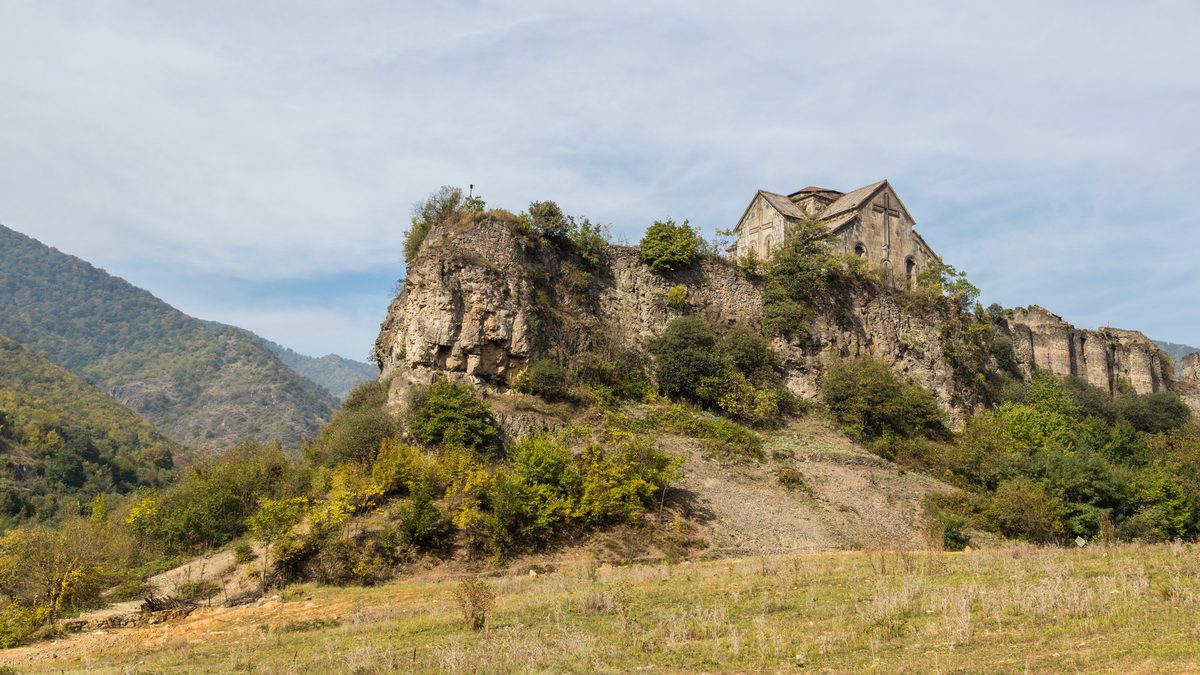
Akhtala's frescoes are anomalous. They survived eight hundred years. No one can explain this with perfect certainty. But the reasons are probably these: First, the fortress walls. The monastery sits inside a fortified complex — walls that protected not only the church but the entire structure. This meant the church roof was maintained. A maintained roof meant rain did not pour through the interior, water did not run down the painted walls. Second, remoteness. After the medieval period, Akhtala was never a major settlement. Few people lived there. No one was motivated to plaster over the frescoes. No one was plundering stone from the church and damaging the walls in the process. Third, isolation from the most destructive historical pressures. Unlike churches in the lower towns and valleys, Akhtala's isolated position meant it was less likely to be at the front line of religious conflict. It was a place that survived partly by being difficult to reach.
And perhaps the paint itself was simply durable. Byzantine technique — ground pigment in a lime plaster base — when done well and maintained in a dry environment, can last indefinitely. Akhtala's painters were skilled. The technique was sound.
What Has Been Lost, What Remains
Not all the frescoes are complete. The faces on some figures have been scratched out — iconoclast damage, probably from the Safavid period when religious authorities were particularly strict about representations of sacred figures. You see a body in full color, a robe, hands, and then where the face should be, scraped stone. The theological image without its most human component.
One section of painting on the south wall was damaged by water infiltration in the 20th century, before the monastery was properly maintained. The paint flaked and fell. That section is now mostly bare stone. But the damage stopped there. The wall was repaired. The roof was secured. The rest of the frescoes held.
What remains is remarkable precisely because it is incomplete. The Pantocrator still has his face and his colors. The Dormition scene is legible — you can read the narrative in the arrangement of figures. The Last Supper on the north wall shows the table with food, the disciples in conversation, Christ in the center, and yes, the reds have dulled to a rust color and the blues have faded but they are still blue. The gold leaf that once covered the halos has tarnished to brown, but the image is still there.
How to See Them
The church interior is dim. Akhtala is not a functioning monastery with windows designed for light — it is a fortress church, thick-walled and defensible. Inside, the stone holds the cold and the darkness. You come in from daylight and you can see almost nothing for a moment.
But your eyes adjust, and then the frescoes emerge. You walk closer to the walls. Details appear. The brush work becomes visible. The style becomes clear. You are standing three feet from paint that was applied to this wall in the year 1200, approximately.
A flashlight helps immensely. A phone torch is enough. You point it at the wall and suddenly the colors leap forward — the reds and blues of the Dormition, the detail of the faces where they remain, the gold of the background. The monk who lives in the monastery — there is usually a monk, or someone who tends to it — will tell you where to look. He will have his own torch. He will take you to the clearest sections. He will point out the details you would miss: the cup on the Last Supper table, the gesture of blessing in the Pantocrator's raised hand, the weeping of the disciples at Mary's death.
Then you step outside. The light returns. You walk out into the fortress courtyard and the change is disorienting — the brightness, the space, the sound of wind in the canyon below. But inside, the frescoes are still there, still holding their color in the dark, still telling their eight-hundred-year-old story to anyone who brings a light and looks carefully.