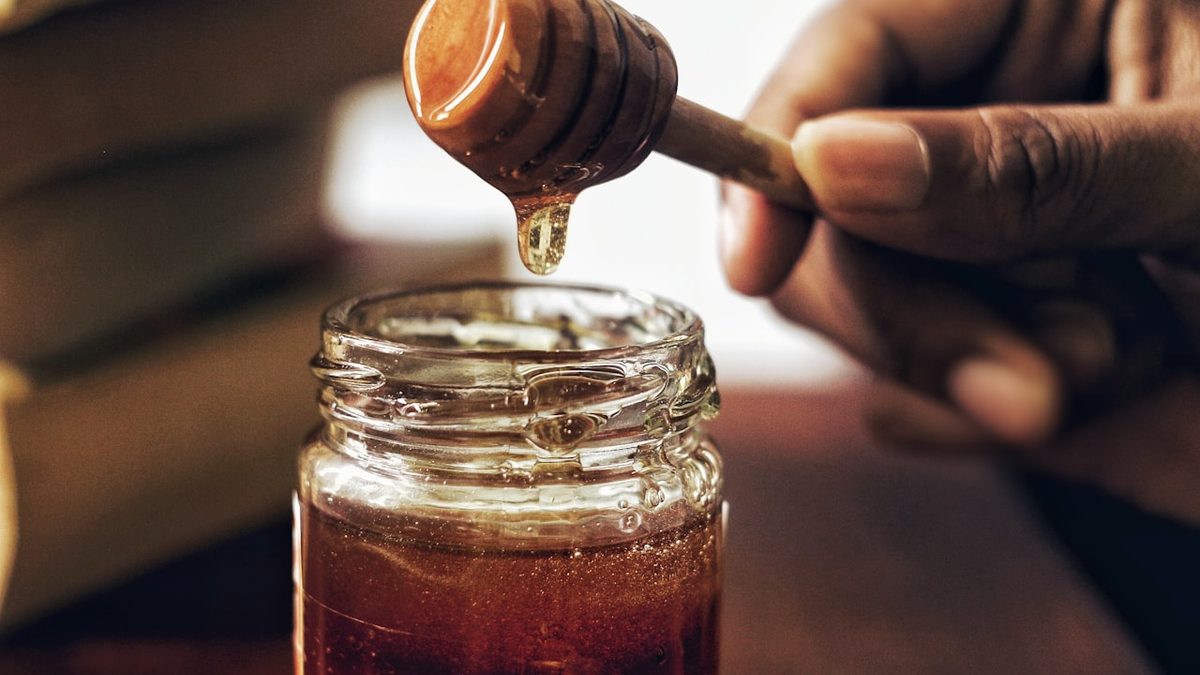
Arshak keeps forty hives at the forest edge, a twenty-minute walk from Akner. He is in his seventies. He has kept bees here for forty years. He moves through the hives the way a person moves through a place they know completely.
The Walk to the Apiary
You leave the village on the path north, past the last houses, past the chicken enclosures and the wood stacks, and into the open slope that rises toward the forest. The path is clear. People use it. Arshak walks it every day between May and October, sometimes twice a day.
The apiary sits on a gentle slope where the forest begins to thicken. There is no fence. The hives are simple wooden boxes, painted white and red, arranged in rows facing south and east. Forty of them. Some are new; some are old enough that the wood is weathered to gray. Arshak built most of them himself.
The first time you approach, the bees feel like a threat. They feel like an army. There is a sound — a low collective hum that is hard to describe to someone who has not heard it. It is not angry. It is purposeful. Arshak walks into it without hesitation. He moves like a person entering a room full of people he knows.
The Taste and the Work
Lori's honey is specific to the place. The forest produces three kinds across the year. Linden honey comes in late summer — it is pale gold, delicate, almost floral. It tastes like the tree itself somehow distilled. Chestnut honey comes in early autumn, darker, more bitter, with a mineral edge. Then there is wildflower honey from spring, which varies year to year depending on what bloomed.
Arshak shows you how to read a hive. He opens a box carefully, lifting the frame toward the light. The bees cover it. He brushes them aside gently — not swatting, just moving them. He points to capped cells. That is honey ready to harvest. Open cells still being worked on. The comb in the middle, where the queen lays her eggs.
The fresh comb honey tastes completely different from the jarred honey. You eat it as it is — wax and all — biting down and feeling it dissolve. It is alive in a way that jar honey is not. Arshak cuts you a piece from a frame and watches you taste it. He doesn't talk while you eat. He just watches.
The work is patient and repetitive. Checking each hive takes an hour. Arshak looks at the population, the food stores, the laying pattern of the queen. He watches for disease. He listens to the sound the hive makes. "That one is sick," he says of one hive, pointing to nothing you can see. "The sound is different." He has been listening to hives for forty years.
The Forest Is Changing
Arshak talks about the bees the way some people talk about the weather — as a constant conversation with something larger than yourself. He says the summers are hotter now. The bees are stressed. They swarm more when they are stressed — they leave to find a better place. When they swarm, you lose them.
The linden bloom is coming later. When he started keeping bees, the linden flowered in July. Now it flowers in late July or August. That changes the timing of everything. The bees need to build their population early enough to take advantage of the bloom when it comes.
The wildflower honey is less predictable. Some years there is a glut. Some years barely enough. Arshak says it depends on the rain. Too much rain too late and the flowers don't set seed. Too little and they wilt before the bees can work them. "We cannot control this," he says. "We only adapt."
The Honey Economy
Arshak sells honey locally in Akner — to villagers, to people passing through. He gets 6,000 dram per kilogram from local buyers (about $15 USD). But his main buyer is a man from Yerevan who comes in October after the main harvest. That man buys 60 to 80 kilograms most years and pays 4,500 dram per kilo (about $11 USD) at the farm gate. The same honey sells in restaurants in Yerevan for 25,000 to 30,000 dram per kilo.
Arshak does not resent this. He says he is not a businessman. He keeps bees because he likes keeping bees. The honey pays for the sugar he feeds them in winter, for the new equipment he needs to replace broken boxes, for the time. It is not a living. It is income from something he would do anyway.
He has turned down offers to expand. He has been asked by people in Yerevan to scale up, to produce more. He says forty hives is the right number. It is manageable. It lets him know each hive individually. It lets him notice when something is wrong. More than that and you are managing a business instead of keeping bees.
Where to Buy Lori Honey
If you visit Akner or Alaverdi, ask locally for honey. Most villages have someone who keeps bees. You can buy from them directly — the price will be fair and the honey will be fresher than anything shipped from Yerevan. Ask specifically for linden honey if you visit in late summer or early autumn. It is the signature honey of Lori, and the taste is nothing like the linden honey you might have tasted elsewhere. This one grows in these mountains. It tastes like them.