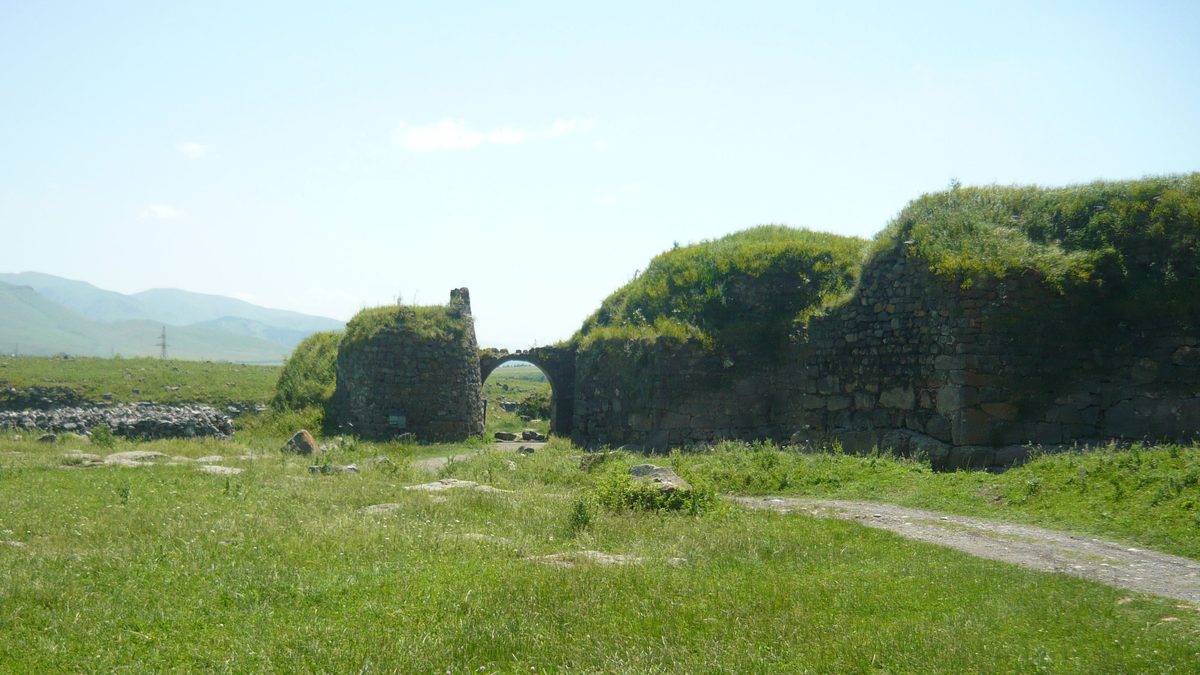
Kayan sat above the Debed for five centuries. It fell in an afternoon, because a woman told the Lezgins where the spring was.
The Fortress Above the Canyon
Kayan stands on a rocky spur that juts out above Akner village, 400 meters above the Debed canyon floor. The fortress itself is fragmentary — broken walls of pale stone, some sections still standing shoulder-high, others reduced to foundation lines in the grass. But the position is unmistakable. From the spur, you can see north into the Debed gorge, and south toward the village. It was a place that saw everything.
What you see now is not grand. There are no towers intact, no gates, no dramatic ruins. Just stones in the grass, arranged in patterns that once meant something. The walls were built with the pale limestone of the region, fitted without mortar in places, with mortar in others. The work is competent. This was not a hastily built stronghold.
It is unvisited. There are no signs pointing toward it from the village. No marked path. No one sells postcards. Most people who walk through Akner have never heard of it.
When It Mattered
Kayan was one of the most powerful fortresses in medieval Lori. It controlled the canyon approach from the north — the pass that connects the Debed valley to the routes leading into Caucasia. A fortress in that position could levy taxes, deny passage, demand supply. It was wealth and power made concrete in stone.
We know little of its history in detail. There are Armenian sources that mention it, but the fortress changed hands across centuries — controlled by local Armenian nobility, then by the Mongols, then by regional powers whose names are now difficult to pin down. It was strong enough to matter and weak enough eventually to fall.
The strongest thing about it, as it turned out, was not its walls.
The Siege and the Woman
The fortress fell to a Lezgin siege. The Lezgins came from the north, from what is now Dagestan, and they came to take what was valuable. A fortress controlling trade routes was always worth taking.
The defenders of Kayan had one crucial advantage: a spring. It delivered water from somewhere inside or near the fortress down into the canyon and down to the village below. The spring meant the fortress could withstand a siege. You could wait out an army if you had water.
An elderly woman from the village — the sources do not give her name — knew where the spring ran. She had lived in Akner all her life. She walked to the spring to fill her water vessels. She knew the path, the rocks, the stones. One day, either because she was threatened, or paid, or decided the siege was pointless, she told the Lezgins where the spring was located.
They found it and they cut it. The water stopped flowing. Without water, the fortress could not hold. The garrison surrendered in an afternoon.
The Name That Remained
After the fortress fell, after the siege was over, something odd happened to the village's name. Before, it had been called Vornak. The name comes from a question in Armenian: Vor nak? — "Where is Ak?" Ak was the spring. When the Lezgins cut it, the water disappeared. The question became literal. Every villager asked the same thing: "Where is Ak?" The question became so common, so much a part of speaking about the catastrophe, that eventually the place took the question as its name. Vornak: the village defined by a lost thing.
In the 1930s, the village was renamed Akner — "the springs" — a positive inversion. The springs were gone, but the name would claim them back. The village still carries the memory of water loss in its official title.
An underground stone pipeline, called a Dsevank in Armenian, once carried water from the fortress area south through the village. Sections of it may still be visible if you know where to look — stones laid to channel water through the earth. It is a different kind of engineering than the fortress walls: patient, practical, designed to move something precious from one place to another without letting it escape.
How to Find It
From Akner village, walk north toward the canyon. The fortress sits on a rocky spur above you. It is accessible but not marked. The stones are there. The grass grows around them. The canyon spreads below. No one stops you. No one announces that you have reached somewhere that mattered.
There is an honesty to it. The fortress did not survive because its walls were too strong or its position too clever. It survived for five hundred years because of a spring, and it fell when that spring was betrayed. The woman who told where the spring was — she changed everything in an afternoon. She is not named in any source. The fortress walls remain, but her name is gone, and the village carries the scar of what she did in its name.