The tour buses leave around 4:30 PM, pulling out of the parking area with the mechanical certainty of creatures that have somewhere to be. By 5 PM, Haghpat Monastery is quiet in a way that doesn't exist in guidebooks. The shift from crowded to empty is sudden and nearly absolute. If you stay—if you make the walk up from the village parking area when everyone else is heading down—you experience something that most people who come here never see: the place as the monks knew it, as the stones have been for a thousand years.
The Fifteen-Minute Ascent
The walk from the parking area to the monastery complex takes about fifteen minutes if you move at a normal pace and stop to look at the medieval khachkars (cross-stones) that line the upper part of the path. The village of Haghpat sits above the Debed River gorge, and the monastery sits above the village, so the approach is constantly upward but not steep enough to be laborious. The path moves through the village proper for the first five minutes—past a small market stall that closes at 4 PM, past the school building, past houses with carefully maintained courtyards where vegetables are grown in orderly rows.
Then the village loosens its grip and you enter something closer to wildness. The path becomes narrower. Trees—poplars mostly, and some fruit trees—begin to appear more frequently. The sound of the village below fades. The air, even in midsummer when the heat has been substantial, cools slightly with elevation. You can smell the dust of the path mixing with leaf smell, with the specific scent that old churches have, which is a combination of stone, time, and something else that might be incense but might just be the accumulated presence of many people across many centuries.
The Stones Themselves
Haghpat was built beginning in the 10th century, though most of what you see dates to the 13th and 14th centuries. The main church—the Surp Nshan (Holy Sign Church)—is a classic Armenian structure: a domed chamber topped with a conical dome, relatively small, proportioned so that the interior feels both intimate and grand simultaneously. The tuff—the porous volcanic stone used throughout Lori—is a particular shade of reddish-brown. In the intense afternoon light, it can look almost purple. In the evening light, when you arrive around 5 or 5:30 PM, it shifts to something warmer: a deep golden-red that seems to contain light rather than reflect it.
The gavit—the narthex or entrance hall—is attached to the south side of the main church, a more recent addition (14th century) that expanded the complex and served as a secondary gathering space. It is decorated with stone reliefs that, by evening light, throw deep shadows, making the carved details more visible than they are in harsh midday sun. The doorway into the main church is framed by ornamental stonework that is among the finest medieval Armenian architectural carving you will see anywhere.
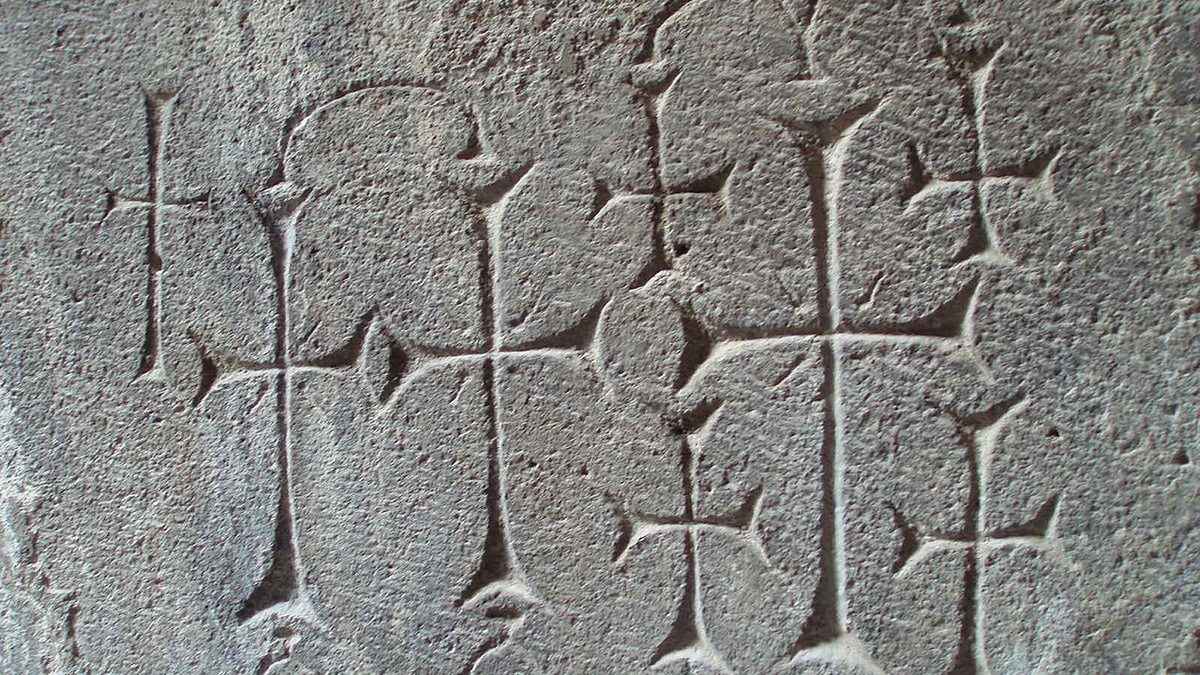
Scattered throughout the courtyard are khachkars—dozens of them, ranging from relatively simple designs to incredibly intricate carved crosses. One khachkar at Haghpat is dated to 1273. The carving is so detailed that, in late evening light, you can see the individual elements clearly: the central cross, the geometric patterns that frame it, the small decorative flourishes around the edges. The khachkars are arranged somewhat haphazardly—they are not in a planned layout so much as accumulated over centuries—which creates an effect of intentional scatter, as if the monks were placing each one in the place where it felt right.
There is a bell tower, rebuilt in the 1800s after an earthquake but following the medieval design. The refectory is also present, though less dramatically than the main church. The stone benches inside the refectory are worn smooth by centuries of monks and visitors sitting to eat. The stone table still stands, though nothing is eaten there now.
The Cats
Every Armenian monastery has cats. This is not a metaphor or a poetic observation—it is an actual fact. The cats appear to be permanent residents, neither quite feral nor domesticated, but occupying a specific niche as the monastery's mouse and rat control system and its unofficial welcoming committee. At Haghpat, there are at least four cats, all with the independent bearing of creatures that have lived long enough to develop opinions.
The large orange cat appears around 5:30 PM from somewhere behind the refectory and makes a slow circuit of the courtyard, investigating whether anyone has brought food. He does not purr. He is interested rather than affectionate. By 6 PM he has established that you have no food and removes himself to a corner of the refectory wall where he sits with his paws folded, watching the light change.
A smaller grey cat is visible only briefly—she materializes near the bell tower, observes the decreased foot traffic with apparent satisfaction, and then vanishes into the structures with the ease of a creature that knows every gap in these stones. A third cat, so dark it is nearly black, can be heard more than seen—a meowing from somewhere in the depths of the complex, unanswered by any other cat, a solitary sound that echoes slightly off the stone.
These cats matter because they remind you that this place, for all its historical significance, is not a museum. It is still inhabited. Life still moves through it. The presence of the cats—occupying the same space the monks did, hunting in the same courtyards, sleeping in the same corners—creates a continuity that a perfectly preserved but emptied site would lose.
The Light Shift
Between 6 PM and 7:30 PM in midsummer, the light at Haghpat changes with remarkable speed. The golden-red light I mentioned shifts to orange, then amber, then something that has almost no name—a quality of light that is the sun getting lower without anything being in actual shadow yet. The tuff of the church walls seems to absorb this light and hold it. The relief carving on the gavit's doorway becomes almost three-dimensional. The khachkars cast long shadows that form strange geometric patterns across the stone courtyard.
The sound changes too. The human noise—the voices of the tour groups, the occasional vehicle in the parking area far below—fades completely. What remains is the wind, which is often quite persistent at elevation in Lori, and occasionally, from far below, the sound of the Debed River. There are birds—I heard what I think were ravens, though I am not confident in bird identification. The sound of them is deeper and rarer than the usual sparrows you hear around villages.
The temperature drops noticeably. If you have been watching from 5 PM onward, you feel the shift in your body: the heat that was oppressive in the afternoon is simply gone. This is when you might sit down on one of the khachkars or on the stone bench outside the gavit. This is when the place begins to feel like it belongs to you, not in the sense of ownership but in the sense of genuine presence.
The Woman in the Blue House
On the walk back down around 8 PM, when darkness is complete but not yet absolute, I encountered an older woman sitting on the terrace of a house that sits perhaps twenty meters from the main monastery gate. She had a demeanor that suggested she was waiting for something, though she was also clearly simply present, watching the street.
She told me, when I asked, that she had lived in that house for forty-two years. Her husband had passed fifteen years ago. Her children were in Yerevan. She lived alone and watched tourists walk past, watched the monastery, watched the seasons change across the gorge. She had seen the shift from when Haghpat was essentially unknown (1980s and early 1990s) to when it became a standard stop on tour itineraries (2000s onward) to now, when thousands of people come each year. She seemed to view this transformation with the kind of equanimity that only comes from having a home that remains unchanged while the world around it transforms radically.
"Most visitors don't stay after the buses leave," she said. "They come in the afternoon when everyone comes, and then they leave when everyone leaves. So they see the monastery but not the place." I understood her meaning: the monastery as a historical object is visible in daylight, in crowds. But the place—the specific quality of presence that emerges when you're alone with the stones at dusk—requires time and solitude.
The Dark Return
By 9 PM, Haghpat is completely empty. The gates to the main church are closed (this happens around sunset, at the formal discretion of whoever the current caretaker is, though the courtyard itself remains accessible). The monastery is no longer a tourist destination. It is simply a place where Armenian monks built structures that have endured for a thousand years and are still enduring, still containing light and shadow and the presence of cats and wind and occasionally, on an evening in midsummer, a solitary visitor who stayed long enough to understand why these stones still matter.
The walk back down to the village in near-complete darkness is the kind of experience that is only possible in a place you have just become familiar with. The path is clear enough to follow—your eyes adjust—and the village lights below serve as a gentle beacon. You move carefully but without fear. The air is cool. The sound of the river is louder now, or perhaps just more noticeable because there is less competing sound. When you reach the parking area and the village lights, you feel the shift back into the contemporary world, which is immediate and jarring.
Stay Local to Experience Haghpat Fully
The monastery is best experienced across at least two visits: morning light and evening solitude. Staying overnight in Alaverdi or at a guesthouse in Haghpat village allows you to visit the monastery on your own schedule, away from tour groups.
Find a Guesthouse →