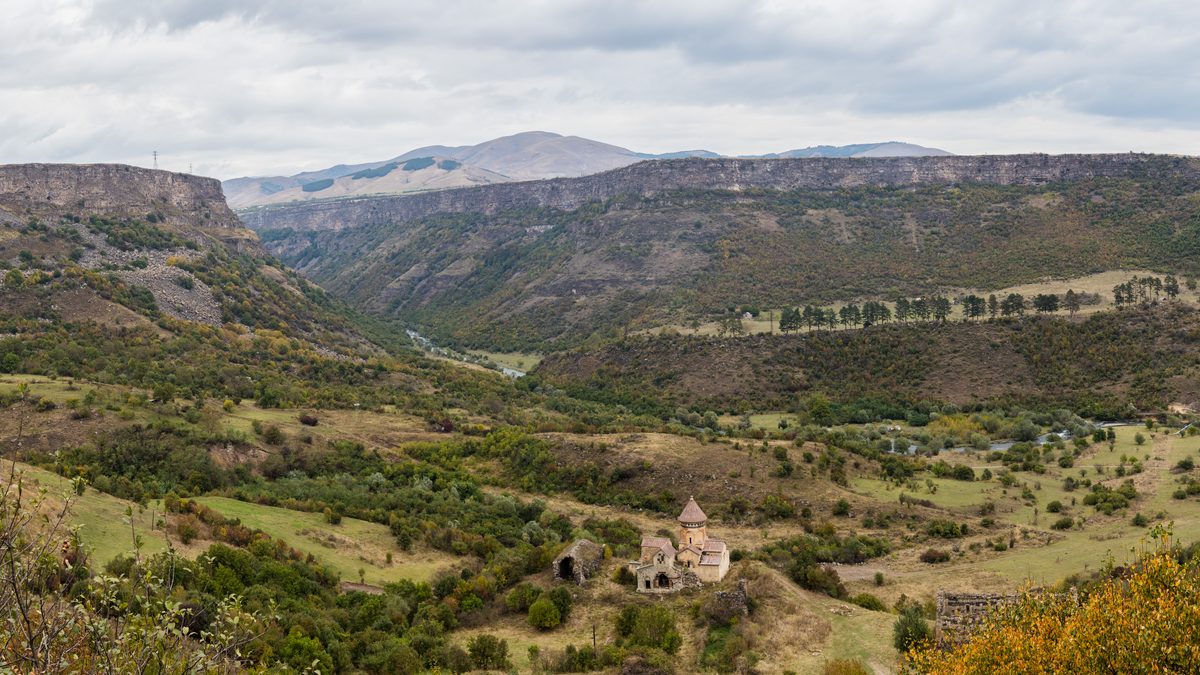
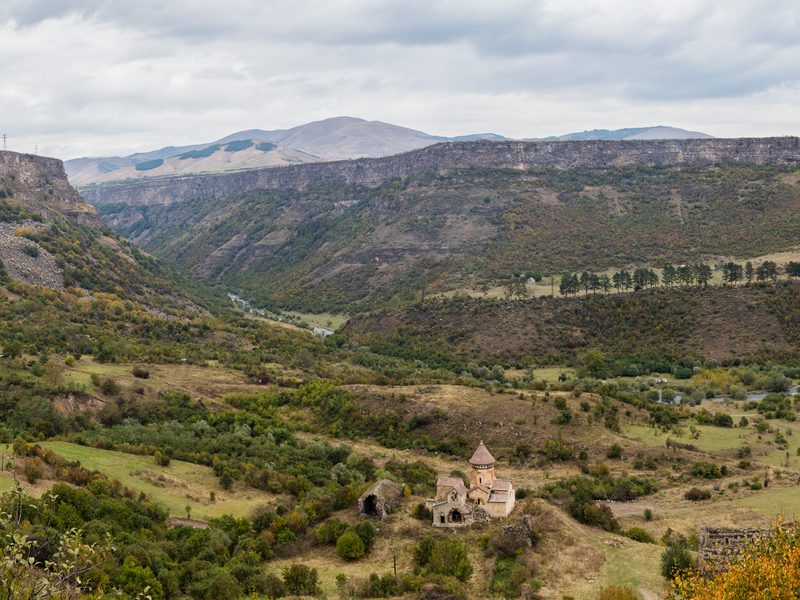
Stand at the rim of the Dzoraget Gorge in late April, when the snow has just pulled back from the upper meadows, and look down. The canyon walls are rust-red, brick-orange, the colour of dried blood or old terracotta. That colour is tuff — volcanic ash compressed into stone over 2.5 million years — and it is the defining material of Lori's entire built landscape.
Every church, fortress, and farmhouse in this corner of Armenia is made of it. The Lori Berd fortress — the cliff-peninsula capital of the Kingdom of Lori, abandoned in 1105 — rises from the same material it stands on. The 10th-century bell tower of Haghpat, which you can spot from the road seven kilometres away, is tuff cut to the precision of a jeweller's art. The windowsill of the half-collapsed house at the edge of Akner village where nobody has lived for thirty years — tuff.
What the geology says
Lori sits at the convergence of three tectonic plates: the Eurasian, Arabian, and smaller Anatolian. For millions of years this zone has been volcanically active. The great eruptions of the Pliocene epoch, roughly 2–5 million years ago, deposited enormous quantities of ash and pyroclastic material across what is now northern Armenia. Over time — through heat, pressure, and the slow chemistry of groundwater — this loose ash lithified into tuff: lightweight, porous, easily cut with hand tools, and yet structurally capable of spanning decades, centuries, millennia.
The specific variety found along the Dzoraget River and its tributaries is known informally as Dzoraget tuff, distinguishable by its reddish-orange hue. The colour comes from iron oxide — essentially rust — within the ash. When freshly cut, the stone is a warm ochre. As it ages and weathers, it deepens to the red-brown you see lining the canyon walls. A skilled mason can date a cut stone roughly by its colour alone.
Building in tuff
The Armenians did not discover tuff — they inherited it. There is evidence of tuff quarrying in the Lori basin going back at least 3,000 years, to the Urartu period. But it was the medieval Armenian kingdom-builders of the 9th through 13th centuries who elevated tuff construction to an art form so refined that UNESCO, nine centuries later, placed two Lori monasteries on its World Heritage List.
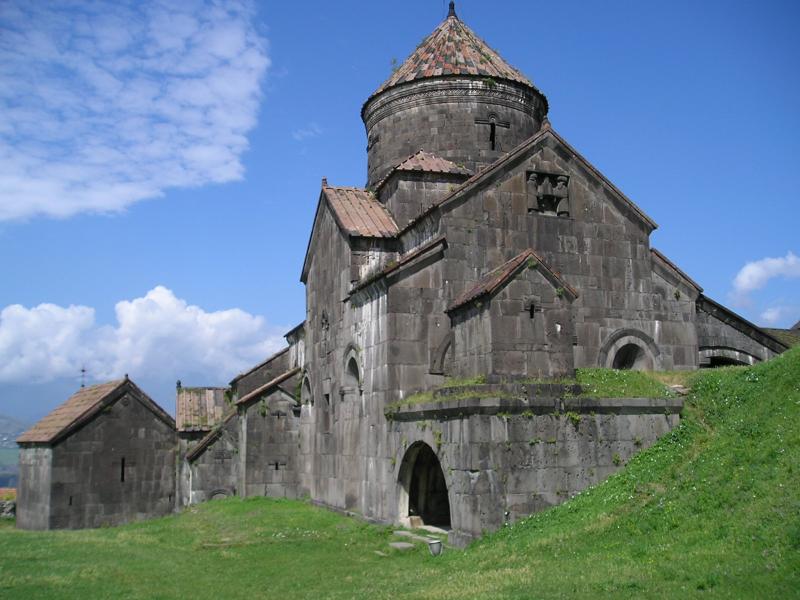
What made tuff useful was precisely what made it seemingly weak: its porosity. A freshly quarried tuff block is relatively soft — it can be carved with iron tools without the effort required for granite or basalt. Decorative stonework that would have taken weeks in harder stone could be achieved in days. The intricate interlace patterns on the façade of Haghpat's main church, the blind arcading along the walls, the khachkar crosses whose negative space is as carefully composed as their positive form — all of this was possible because the stone cooperated.
The trick was that once cut and exposed to air, tuff hardens. The same porosity that makes it workable allows moisture to evaporate and the stone's internal chemistry to continue: a slow strengthening that can take decades. The builders knew this. They quarried in spring and summer, shaped through autumn, and left blocks to season through winter before installation the following year.
Reading the canyon like a book
Walking the Dzoraget Gorge loop trail from Stepanavan, you pass through a cross-section of this history in the span of four hours. The canyon walls expose different tuff strata — different eruptions, different ages, subtly different colours. Early Armenian builders learned to select by layer: the denser, darker material for load-bearing walls; the lighter, more easily carved material for decorative elements; the very softest tuff for the interior tunnel-vaults that are Haghpat's structural signature.
About two kilometres in, the trail passes a series of niches cut into the cliff face — small chambers, just large enough for a person to sit. These are hermit caves, carved by monks who wanted isolation even by the standards of a monastic community. The rock around each niche shows the marks of iron tools: short, parallel strokes, the signature of hand-cut tuff that hasn't changed since the Middle Ages. The most recent of these carvings, according to archaeologists who have studied them, dates from the 17th century. Some may be far older.
Lower in the gorge, where the trail follows the river bank and the canyon narrows, the tuff gives way to basalt: darker, harder, volcanic of a different era. The contrast is stark. Basalt was the stone of choice at Haghpat's neighbour Sanahin, five kilometres south, and accounts for the different visual character of the two monasteries despite their near-identical age and architectural school. Haghpat is warm; Sanahin is austere.
What the stone remembers
The most affecting quality of Lori's tuff architecture is not its age but its continuity. People still build in tuff here. Drive through any village in the Dzoraget or Pambak valleys and you'll pass houses whose newest wall is fifty years old and whose oldest is eight hundred. Farmers repair traditional stone walls with the same material the walls are made of, sourced from the same hillside outcrops their great-grandparents used. The colour match is imperfect — new cuts are lighter — but the material is the same.
At the edge of Akner village, an elderly man named Gagik showed me his barn wall last April. The lower three courses are original, he said — medieval, probably 13th century, cut with hand tools in a style he recognised from his grandfather's descriptions. The upper two courses he laid himself in 1987. He pointed out the difference in the tool marks. The medieval blocks show circular gouge patterns; his own work shows the straight lines of a modern chisel. But both are tuff. Both will last.
There's something in this that is distinctly Lori — a relationship to landscape that is not sentimental but practical. The stone is here; it has always been here; it will continue to be here. The kingdom rises and falls, the Soviet Union comes and goes, the young people leave for Yerevan. But the canyon is not going anywhere. The tuff remembers what the people sometimes forget.
Walk the canyon yourself
The Dzoraget Gorge Loop departs from Stepanavan town and covers 12 km with 480 m of elevation. Best in April–May when the wildflowers are out and the canyon light is at its sharpest. Allow 4–5 hours. No technical skill required — sturdy footwear and water.
Trail details →